Why You Need to Stop Dieting and Eat More to Heal
If you’ve spent your life in the fitness, bodybuilding, or chronic dieting space, you’ve likely been conditioned to view your body through a lens of subtraction. Less food. Less space. Lower body fat. Less of you.
After years of personal struggle as both a coach and an athlete, I came to a radical understanding: to rebuild your capacity and truly heal, you need to disregard the scale weight and intentionally eat more.
My history of chronic restriction and bodybuilding.
I know this restrictive world inside-out. My own cycle of restriction started when I was just 13 years old. By 18, I was fitness-obsessed and became a personal trainer. From my mid-20s to my early 30s, I was competing in bodybuilding and powerlifting, and from 2012 onward, I coached others to do the same. For over a decade, I operated as a weight loss and competition prep coach, knowing exactly how to manipulate variables to make a human body smaller.
But behind the scenes, my body was keeping score.
In 2014, I was hit with chronic fatigue, which sparked a long, ongoing healing journey. Over the years, my coaching philosophy naturally began to shift away from rigid control and restriction toward holistic health, nervous system regulation, and true healing. In fact, I am currently phasing out prep coaching entirely, with only one long-term competitor left in my roster.
Yet, even as a coach who deeply understands metabolism, I found myself stuck in my own mental trap. I didn’t want to gain weight, and I was constantly controlling my food intake to ensure that did not happen.
After moving to the Gold Coast in 2026, I realised I wasn’t getting anywhere anymore. My chronic fatigue was still heavy, my training performance was on a constant decline, and I was waking up every single morning with a wave of dread, thinking: How am I even going to get through this day?!
I forced myself to look at my situation from an outside perspective and finally faced the truth: I was only eating 150 grams of carbohydrates a day.
For my history and my physical output, I was chronically under-eating. I was trying to heal a depleted body on a fraction of the fuel it actually required. For context, I won’t let a client my size eat less than 125 grams of carbs per day even when they are completely competition-ready. Carbs are crucially important for your training, hormones, recovery, and mental health.
So, 10 weeks ago, I made a terrifying choice. I chose to start a re-feeding journey—or what is clinically referred to as nutritional rehabilitation. I doubled my carbohydrate intake to 300 grams a day.
Here is exactly what happened when I did.
The confronting reality of a metabolic re-feed.
When we read about metabolic healing on social media, it looks like a linear, beautiful transformation. Women eat everything they want, often hitting 3,000 calories a day, and then suddenly they magically lose weight and end up perfectly lean.
The reality is much more confronting.
Since increasing my food intake, I have gained approximately 5 kilograms. And if I’m being completely honest with you, I feel a bit fat right now.
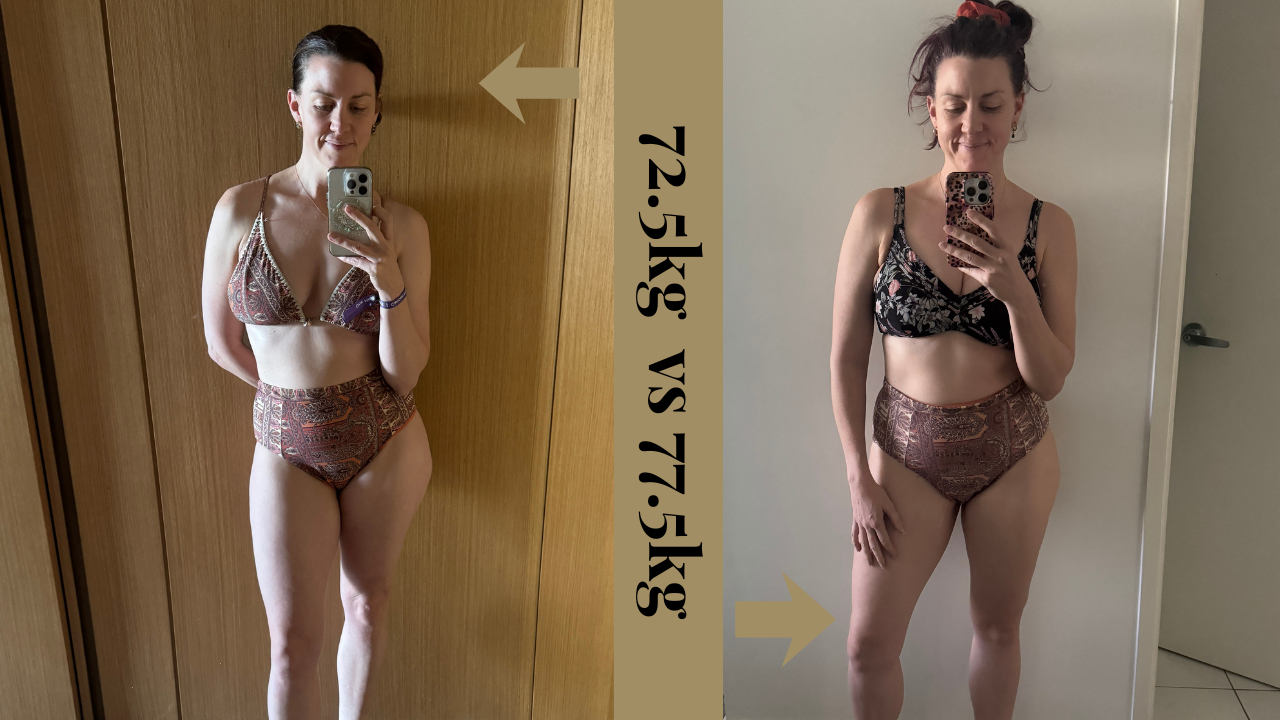
When you have spent your entire adult life controlling your physical size, watching the scale tick upward and seeing your body composition change triggers every single old alarm bell in your nervous system. I am actively dealing with those "I'm fat" thoughts on a daily basis. I ask my partner every few days if he thinks I’m fat or if I’m at an "acceptable level of fat." I feel my clothes getting tighter, but I keep going anyway—because I need to restore my health.
I am staying fiercely focused on the bigger picture. I have to constantly remind myself that this temporary discomfort is a necessary, non-negotiable part of the healing process. Because alongside the weight gain, something else shifted:
-
The morning dread is completely gone.
-
My training is noticeably better (even though my recovery isn't 100% there yet, the spark is coming back).
-
The desperate, primal hunger has vanished. I used to constantly reach for pure protein and fat just to try and quiet the insatiable hunger and constant food noise. Now, I eat when I want to, not because I am utterly starving. This has been a dramatic psychological shift.
To manage the pace of this physical transition and slow down the rapid weight gain, I’ve recently titrated my carbs slightly to around 200-220 grams/day. It’s a continuous process of listening, adjusting, and regulating, while ensuring that I never go back to the restriction that broke me in the first place.
Dieting will always be there. I’ve promised myself that if I feel better for a few consecutive months (I'm not quite there yet) and I am still uncomfortable with my size, I can choose to go through a healthy fat-loss process at a later date.
Signs of under-eating: Are you shrinking your metabolic capacity?
Years of chronic restriction teach your nervous system that resources are scarce. To keep you alive in a perceived famine, your body creates a protective adaptation by slowing down. It down-regulates your thyroid output, dampens reproductive hormones, slows digestion, and keeps your stress hormones incredibly high.
When women compete in bodybuilding, toward the very end of prep, you can tell they are dangerously depleted because they develop a distinct slur—the body doesn’t even have the energy to speak properly.
If you are in this position, you haven't permanently broken your metabolism, but you have shrunk its capacity.
When you live in this chronically depleted state, you might find that you gain weight the moment you eat slightly off-plan, your sleep is fragmented, or you wake up with that same morning dread I experienced—which is often just a massive cortisol spike caused by low blood sugar.
The standard fitness industry advice is always to cut further or work harder. But you cannot reprimand a starved, stressed nervous system into cooperating with you. To get out of the hole, you have to eat your way out.
Since the inception of my coaching business, I have always enforced an "eat more first" approach to weight loss. I get women to follow a higher calorie plan to stabilize their systems and work out exactly where their baseline is. The only exception to this rule is if someone is already genuinely overeating, which is rarely the case with chronic dieters.
If you don’t know how to eat baseline calories, you cannot accurately calculate what your fat loss macros should be. No ethical weight loss coach should ever have you diet straight away without a baseline to work off of.
It’s funny how I completely missed this within myself. I restricted my own carbs in full knowledge that I would gain weight if I ate more. And I did gain weight—but with that weight gain, I also gained more life energy. That is something we should never be restricting ourselves from.
Are you ready to step out of restriction and into expansion?
Re-feeding is the intentional process of feeding your body enough energy to signal to your nervous system that the famine is finally over. It’s about building metabolic and nervous system capacity.
As a former bodybuilding coach, I know how terrifying it is to intentionally put more food on your plate. It completely challenges your identity. It forces you to confront the inner voice that claims your worth is tied exclusively to your leanest state. But I've seen women do it over and over again, and 80% of the time, their food noise and binge eating cycles completely disappear once they intentionally eat more food.
True health isn't a state of perpetual shrinkage. It’s not a matter of becoming as small as you possibly can. We are not here to disappear.
True health is expansion. It is having the physical energy to think, to lift, to sleep, and to live without your entire existence being dictated by a fear of food.
I’m walking this exact path right now, dealing with the mental discomfort every single day, because I am committed to building a body that is Wildly Strong from the inside out. And beautifully, I now have clients who are recognizing their own chronic depletion and following right in my footsteps.
If you are tired of fighting your own biology, it is time to stop subtracting. It is time to feed your body, brave the discomfort of growth, and trust the healing process.

Are You Ready to Step Into Expansion?
Re-feeding is the intentional process of feeding your body enough energy to signal to your nervous system that the famine is finally over. It’s about building metabolic and nervous system capacity.
As a former bodybuilding coach, I know how terrifying it is to intentionally put more food on your plate. It challenges your identity. It forces you to confront the voice that says your worth is tied to your leanest state. I've seen women do it over and over again and most of the time, women say that 80% of their food noise and binging has disappeared once they intentionally eat more food.
True health isn't a state of perpetual shrinkage. It’s not a matter of becoming as small as you possibly can. We are not here to disappear.
True health is expansion. It is having the energy to think, to lift, to sleep, and to live without your entire existence being dictated by a fear of food.
I’m walking this path right now, dealing with the mental discomfort every day, because I am committed to building a body that is Wildly Strong from the inside out. And beautifully, I now have clients who are recognising their own chronic depletion and following right in my footsteps.
If you are tired of fighting your biology, it might be time to stop subtracting. It might be time to feed your body, brave the discomfort of growth, and trust the healing process.
If this resonates for you and you would like support, feel free to book a free consultation here or check out my coaching services here.
Jen X
Author