Why You’re Trapped in the Restrict-and-Binge Loop: 10 Mindset Mistakes Sabotaging Your Weight Loss

You are trying to lose weight and failing over and over again. You start Monday with the best intentions, only to find yourself face-down in a bag of chips by Thursday, wondering where your 'willpower' or 'motivation' went.
After 14 years of coaching clients through body transformations, I can tell you with absolute certainty: Your lack of progress isn't a lack of discipline. It is a structural design flaw in how you are approaching the process.
When you get stuck in a cycle of constant restarting, it's usually because of hidden psychological patterns that ensure you don't succeed in losing weight and keeping it off.
If you are tired of fighting your own mind, look closely at these 10 mindset mistakes sabotaging your progress - and how to finally shift them.
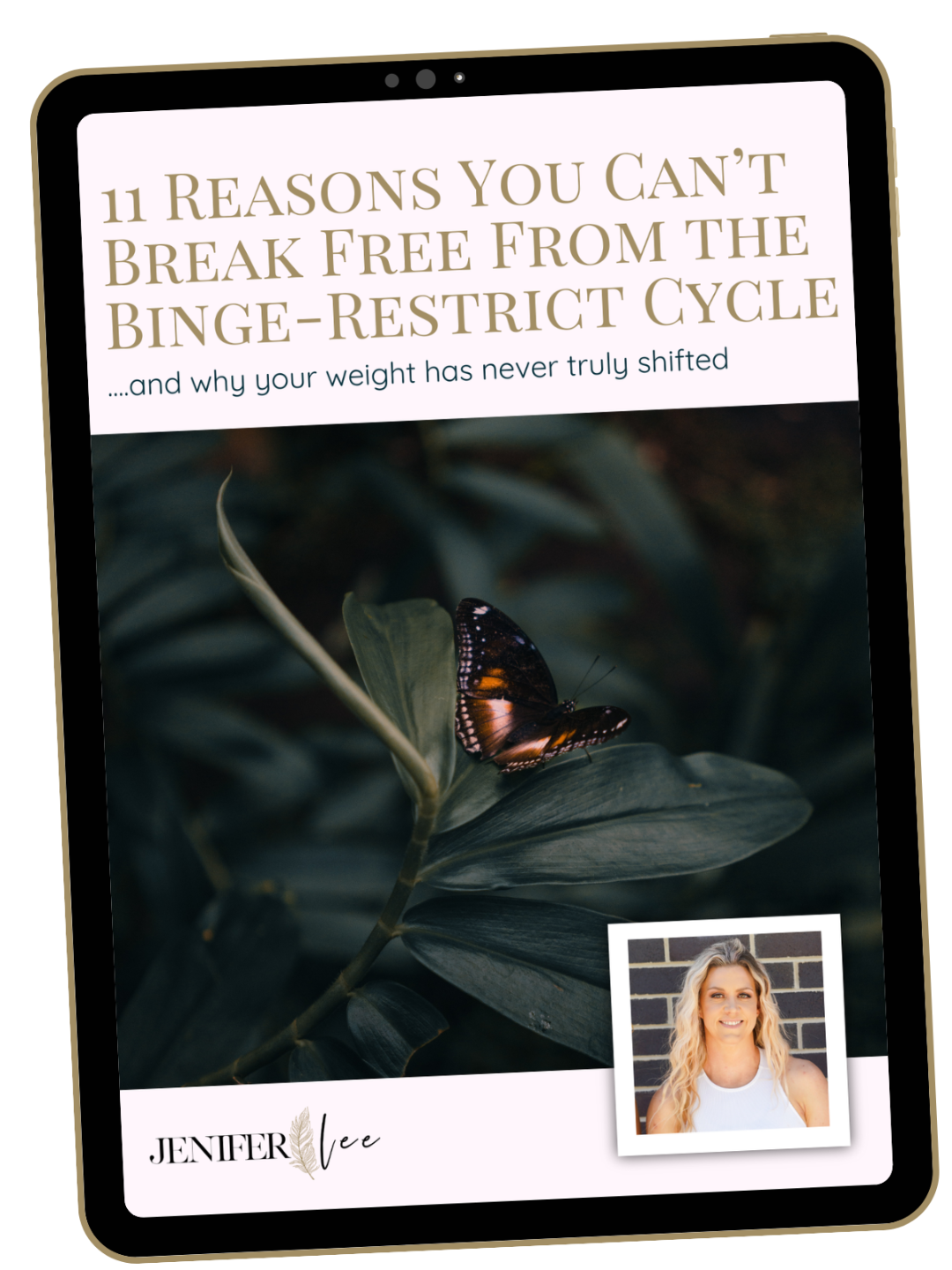
If you're looking for even more content, feel free do download my guide; 11 Reasons You're Stuck in a Binge-Restrict Cycle, and Why Your Weight Has Never Truly Shifted.
1. You rush the process (And trigger a binge).
You want results NOW. So, you try to cut calories harder, add more training, or drastically increase your daily steps. In my early coaching days, clients would frequently get frustrated with their 'light' initial training routines and secretly add more work. I always found out, because it invariably ended in massive binges.
When you do too much, you burn out, over-restrict, and your biology forces a swing the other way. Fat loss isn’t something you force; it’s something you build into your life. The more patient you are throughout the process, the easier it will be and the faster you'll reach your goal.
2. You judge yourself when you slip up.
You eat something “off the plan” and immediately assume this means something negative about your character. You decide you’re "weak," "undisciplined," or "back at square one." Instead of simply correcting and jumping back on the plan, you spiral.
Sometimes, one single slip-up becomes an excuse to give up entirely for a week. Real progress comes from consistent course correction, not perfection. Nobody is perfect.
3. You label food (or yourself) as 'good' or 'bad.'
You turn eating into a rigid moral system. "Good" days mean you’re winning; "bad" days mean you’ve failed. Then, on a "bad" day, you think you’ve already ruined it and decide to go all in.
Food holds no morality. These labels just create extremes, and extremes lead to inconsistency. Furthermore, you might decide you were good or bad depending on your choices that day. You are not a toddler. You are either "aligned with your goals" or "not currently aligned with your goals." These are the terms I use with my clients. The simplest way around this hiccup is to drop the judgment and just jump back on the plan.
To conquer this aspect of eating, check out my short-course on flexible dieting, which is all about balancing food intake to include the things you love (and overcome that moral view of food!).

4. You default to self-criticism over self-forgiveness.
You believe that being harder on yourself will make you better, so you pick yourself apart. Whether it's your body, your effort, your consistency, or your scale results, it's vital to know that self-criticism doesn’t build discipline—it creates psychological resistance.
The clients who actually change their bodies aren’t the ones who are the harshest on themselves. They’re the ones who can face the truth without tearing themselves down. They choose to be self-forgiving rather than self-deprecating.
5. You’re not fully honest with yourself (or your coach).
You say, “I followed the plan,” but you didn’t—not fully, and not consistently. Underneath that lie is usually deep shame, not laziness. To protect your identity and avoid feeling like a failure, you protect yourself by avoiding the truth.
This is incredibly common. 99% of the time when I've been perplexed by a "perfectly adhering" client's lack of progress, I've found out later they were, in fact, not following the plan. If you have a coach, you need to be honest with them. A good coach will never judge you; they will merely help you get back on track. Progress only responds to reality.
6. You rely on motivation instead of structure.
You wait to feel like doing the work, and when you don’t, everything drops off. Consistency isn’t built on motivation; it’s built on decisions that don’t change based on your mood. Structure carries you when motivation inevitably fades.
If I had waited until I felt like doing something, I would probably have spent my life on the couch—not meal prepping, going to the gym, competing, or building a business. The human body naturally loves to take the path of least resistance, especially when you are overwhelmed.
7. You "all-or-nothing" your effort.
You’re either 100% fully on or completely off, with absolutely no middle ground. But it’s the middle ground—where you are imperfect, flexible, and consistent—that actually leads you to long-term results.
Extremes feel productive in your head, but they are rarely sustainable. You can't rush fat loss anyway, so stop trying to be perfect.
8. You compare your pace to someone else's.
You look at someone else’s body, their results, or their timeline and use it to diminish your own hard work. But you are not seeing their full context; you are only seeing a reflection of your own insecurities.
Most of the time when my clients have secretly "added more" to their program, it's because they compared their routine to someone else's on social media. Imitating another person's routine will do nothing for you. Comparison pulls you out of your own lane, and staying in your own lane is exactly where your power lives.
If you want to read more about this, check out my article: Elevate Your Body Confidence by Avoiding the Comparison Trap - featuring three of my beautiful clients who have completely different bodies.
9. You focus only on the scale.
You let a single number determine how you feel, even when other markers are clearly improving. Your strength is building, your habits are better, and your clothes fit differently, but because the scale hasn't moved, you discount all the positives.
Fat loss isn’t just a number dropping on a plastic box; it’s a physical body growing, changing, stabilising, and slowly improving.
10. You try to “make up” for overeating by starving.
You overeat, so the next day you under-eat. Maybe you overeat at lunch, so you decide to skip your dinner. You miss a workout, so you punish yourself with extra cardio the next day. You constantly swing between extremes instead of simply returning to your base plan.
Your body doesn’t need punishment. It needs consistency, and consistency always wins in the end.
The Shift: Moving from Pressure to Alignment
Notice that none of these 10 behaviours come from a 'lack of discipline.' They come from a place of urgency, shame, pressure, and the desperate need to get it right.
You do not need to do more work. You just need to get back to the plan you had in the beginning, step out of your head, and allow the structure to do the work in the background.
Next Steps
Note that none of these behaviours come from a 'lack of discipline', but rather from a place of urgency, shame, pressure, and the need to get it right. There is no need to do more work, but rather get back to the plan you had in the beginning, and allow it to do the work in the background.
If you're feeling stuck on your weight loss or body transformation journey, you can check out more articles on weight loss here, or read this post How To Burn Fat (And Keep It Off).
I offer comprehensive coaching packages (and have done for 14 years now) You can check out those packages here.
Author